The Voice

Have you heard of the voice?

No, not the TV show, but the voice inside your head that is always talking to you. It’s the one telling you what to do and sometimes pretending to be your friend and keeping you safe. Yes, it’s often pretending to keep you safe.

Have you ever heard the voice say, don’t ask a question because you might look stupid?

Only then to hear a co-worker ask the same question and get praised for it. And then the voice says “you should have asked that question.”

Has the voice ever told you not to ask for business because you’ll look desperate?

Only then to see a lead or prospect work with someone else. And then the voice says “oh, you didn’t want to be too pushy because it would jeopardize your relationship.”

Has the voice told you that your idea will not work?

Only then to see someone else become a millionaire by executing almost the same idea as you had. And then the voice says “maybe you should have tried?”

What else has the voice prevented you from doing?

The unfortunate thing is that you’ll never know, because you listened to the voice. Next time you hear the voice telling you not to do something, really question its motivation. Is it trying to keep you safe or is it really just preventing you from moving forward?

This Moment

How are you feeling right now?

Did you stop to answer the question or did you keep reading?

If you’re like most then you probably didn’t stop. Why not?

Is how you’re feeling not important?

Stop for a moment. Take a deep breath and feel the air flowing through your nose and deep in to your body. Draw your lips back and feel the warmth of your smile radiate through you. Listen for your heartbeat. Pay close attention to the sounds around you. Direct your attention to your body, if you’re sitting then feel your body against your seat and if you’re standing then feel the weight of your feet against the ground.

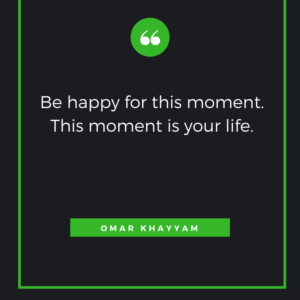
In this moment feel no rush to move on to what’s next. In this moment let everything go and just appreciate the miracle of all that is. In this moment you and everything around you is perfect.  Your entire life is captured in this moment because this is the only moment promised to you.

Self-Talk

How do you talk to yourself?

Do you use words that are nurturing and encouraging or do you continuously beat yourself up?

Your internal monologue with yourself is probably one of the most important things that you can control, yet most pay little attention to it.

Both constructive and destructive self-talk can play a huge part in your daily well-being and how others perceive you. Studies show that leaders that engage in positive self-talk not only perform better at their jobs but are also more likable. This is not surprising because if you don’t speak highly of yourself then how can you expect other to do so.

Engaging in positive self-talk doesn’t mean being self-consumed. It does mean paying attention to what you are thinking and if you catch yourself using negative words like ‘dumb,’ ‘stupid,’ or ‘failure’ to describe your behavior then stop and re-evaluate.

Depending on your personality the habit of constructive self-talk might take some time to feel natural, so start slowly. Choose a simple phrase to start your day with, write it down and get in the habit of saying it every morning and see how it changes your day.

Get a Coach

I can hear you as you read this. Get a coach?

You’re probably thinking, you don’t need a coach because you don’t play a sport. But my friends, life is a sport, and it’s not a spectator sport. As long as you are here you are playing whether you like it or not. The real questions are, how well are you playing and how well do you want to play?

This post was inspired by a friend of mine who shared with me that he recently hired a tennis coach. One of the things I heard him say during our conversation was “I wish I had hired a coach sooner.’  The reason he wished he had hired a coach sooner was that he had seen a noticeable difference in his game after the first coaching session.

Now you may not want to improve in a sport but what about other areas of life. What if you want to be a better parent, spouse or leader? What would even a slight improvement in any of these areas of your life look like?

Getting a coach is probably the best way to improve because you can receive almost immediate feedback and make changes accordingly. But, if you don’t want to get a coach at least find role models or mentors that you can learn from. Remember, the difference between a good life and a great life can almost always be attributed to few small changes being made on a consistent basis.

Take back Control

Who have you given your power to?

Who has the ability to irritate and aggravate you?

Why did you give them the power to do so?

No one can upset you or rattle you unless you let them. Yes, I know this is a bold statement but it is the truth. The ability to control how you respond to the behavior of others is or at least can be in your control.

Learning to control how you feel does take practice because you have been taught over time that it’s okay to blame other people for how you feel. You’ve heard a life time of ‘oh he made me so mad, or she’s really irritating,’ and these statements have played their part in teaching you that your emotions are tied to how others behave towards you.

Try something novel today. If you find yourself getting upset or angry about something just stop for a moment and smile. You might feel a little silly at first, but this one small act will change your entire physiology. It will give you the opportunity to realize that you do have the ability to take back control of your emotions.

Identity

How do you see yourself and how do others see you?

The answers to these questions essentially define your identity. But, what if how you see yourself and how others see you are not in alignment. Even more important is, what if you want to change who you are but those that are most familiar with you refuse to see you as the person you want to become?

As humans it is easier for us to process the world when we are able to put labels or names to things, and this applies to people too. Mother, father, daughter, son, friend, boss etc. allow us to categorize the people in our lives so our brains can continue to process other information. So when people see you a certain way it’s because it helps them better navigate their world.

Fighting back against how people see you is a losing proposition. It’s a battle that really not worth your time or energy. If they are going to change how they see you then it’s something that they have to come to terms with. The best way to deal with it is that you have to act according to how you see yourself allow them to be themselves.

Who do you want to be?

How do you become the person you want to be?

Do you want to be generous, do you want to be healthier, do you want to be smarter, do you want to be a better parent, friend or spouse? The good news is that you can be and the simplest way to do this is to behave like the person you want to be.

Imagine what it would look like if you were actually the person you want to be. What kind of behaviors and habits would that person have? What would their day look like? How would people describe them? For example we’ve all heard someone say. ‘Oh she’s so generous,’ or ‘She’s so healthy.’ They say that because there’s a set of behaviors that a person has that are clearly visible.

So, if there’s an image in your head about the person you want to be then find someone that already fits that image and observe what they are doing. It’s often said that success leaves clues and fortunately this applies to all areas of life.

Don’t Just ‘Google It’

Have you ever just ‘Googled’ something and half an hour later you find yourself looking at a video of cats dancing?

Or perhaps you just wanted to be ‘current on the news’ and again you found yourself watching a video of cats. Trust me you’re not alone. Studies show that the majority of time spent on the internet is wasted time.

The fact that you find yourself aimlessly clicking through websites is not all your fault. The websites of today are designed with the help of psychologists and other experts in human behavior in order to keep you there longer and move you through a funnel. The scrolling and clicking has essentially become an addiction, a mindless behavior.

So, how do you break the addiction? The best way to start is to get in the habit of asking yourself ‘do I really need this information right now?’ Another way is to get into the habit of stop reading after a specific time limit and then to put down or walk away from your device. This gives your brain an opportunity to relax after being stimulated.

Remember the majority of what you are reading is put in front of you for the purpose of showing you advertising. And although you might feel as though you are immune to the ads every pixel on your screen is taking up space in your brain with or without your consent.  So maybe next time, ‘don’t just Google it.’

Stop doing List

Do you have a stop doing list?

Many people have a’ to do list,’ but not many have a stop doing list. This list could include habits you don’t like, over committing your time, perhaps an attitude change towards people or situations.

Here are some ideas for a stop doing list.

Stop saying yes to every request of your time.

Stop over indulging in food and/or alcohol.

Stop making excuses for things you want to do.

Stop procrastinating.

Stop reacting to every text, email, notification and respond on your own time.

Stop complaining about things you can’t change. E.g. The weather, the news, the economy, other people etc.

Stop limiting yourself just because you don’t want to stand out.

Stop comparing your life, business, and relationships to others.

Consuming yourself in your to do’s does not give you the opportunity to focus on your not to do’s. And very often it’s the things you should stop doing that are holding you back. So give yourself sometime this week and focus on one thing you want to stop doing.

Smiling and Dialing

If you’ve ever been in phone sales then you’re probably familiar with the phrase ‘smiling and dialing.’ The reason for smiling before you dial is that it changes your entire physiology and often the person on the other end of the line that can only hear your voice can sense that you are smiling.

Research shows that putting a big smile on your face actually triggers happiness in your brain. Smiling has also shown to improve creativity since a brain in a positive state is open to ideas, which in turn improves problem solving.

Consciously smiling during times of anger or frustration can immediately change your view on a situation. Smiling will send a message to your brain that things will be okay and perhaps aren’t as serious as you think they are.

Making an effort throughout your day to smile will not only enhance your mood and well-being, but will also make you more likable and enjoyable to be around.

Fishing Trips

How many fishing trips do you have left?

I know you might say none because you don’t fish. This is true, but instead of fishing let’s say summers instead. I once attended a seminar where the speaker gave the example of fishing trips to put life into perspective. At the time of his example he was 50 and he said that if he was fortunate to be above average and lived to be 90 then he probably only had 40 fishing trips left. 40 trips might sound like a lot, but if each trip was only 5 days long then 200 days of fishing was all he had left.

Putting your years into perspective can really help you decide if you’re spending your time with people you love and doing things you really enjoy doing. It can also help you realize that many of the small things that might seem so important at the time are trivial in the grand scheme of time.

The unfortunate post script of this story is that the speaker actually died about 4 years after he gave his presentation. This in itself serves a lesson that he had even less time than he thought he did.

Connection through Listening

How much time to do you spend really connecting with people? And how present are you when you are doing so?

The ability to really connect with another individual is a skill that like any other skill has to be continually practiced. Listening plays a key role in connecting. Many times when we think we are listening we are only hearing. Our brain is actually formulating our own responses and preparing to share our thoughts instead of paying attention to what the person is saying.

Listening with intent engages a different part of brain than just hearing. Studies show that if you really pay attention to what another individual is saying then your brain will start to fire the same neurons as the other person. Essentially your brain will sync with their brain which in turn will increase your empathy for them. Increasing your level of empathy will drive you to have more meaningful connections with others.

So, the next time you’re engaged in a conversation, try not rushing to say your next thought. Really just try to listen with an open mind and experience how different the conversation feels. At first this will take some getting used to because it will feel as though the conversation is in slow motion. But over time this practice will lead you to have deeper connections to people you engage with.

Subject to Change

If you’ve read any legal document or purchase agreement carefully then I’m sure you’re familiar with the phrase “Terms and conditions are subject to change.”

The reason for this phrase is that companies know that decisions they make are based on old information and they might need to change their business as they come across new information.

So, are you subject to change too? Or do you continue to base all your future decisions on old information regardless of all the new information you come across.  One way to tell is if find yourself using phrases such as:

This is just who I am.

I can’t see it any other way or can’t do that.

I always do it this way.

I’ve never.

I don’t.

This is how things are or just how it is.

All of these statements are based in a point in time when your experience, education and logic came together to give you a reason for behaving in certain manner. But, what if the information you had relied on was wrong? And you’ve continued to use it to decide who you are today? The next time you find yourself saying or thinking one of the phrases, stop and ask yourself if  you’re ‘subject to change.’

GIGO

In the field of computer science GIGO stands for garbage in garbage out.

In simple terms what this means is that the information you get from a computer is only as good as the information you put in to it. So how does that apply to you? Well, your brain is essentially the best computer the world has ever seen and also works in a similar manner. If you feed it garbage then that’s what you’ll experience.

Some of the most common forms of garbage people feed their brains with are:

Gossip. The he said she said that goes on every day. Fueling rumors about other people based on hearsay. Talking negatively about other people when they are not present also gives you the insecurity that people will talk about you when you’re not present.

Media. Books, TV and movies that feed you stories about how bad the world is. This especially applies to ‘The News.’ Today’s news programs are designed to create fear and negativity and ultimately sell you advertising. Since your brain is programmed for survival it will always be more attuned to negative news, so exposing it to more negativity reinforces the feeling that the world is a bad and dangerous place.

Negative language. Recent studies show that children that are exposed to negative language and continued stressful situations actually have smaller brain sizes than children from healthy homes.

As well as being extremely powerful your brain is also very vulnerable to external influences. It absorbs information and events constantly and is continuously trying to make sense of the world. So, the best thing you can do for your brain and ultimately yourself is to expose it to a healthy environment and as many positive situations as you can.

How do you end Your Day?

How much thought do you put in to how you end your day?

The final minutes of your day before you go to sleep can directly determine your quality of sleep and even to some extent your mood the next morning. Consciously creating an end of day routine is almost as important as a morning routine.

Here a few suggestions for creating an end of day routine.

Turn off screens about 30 minutes before you go bed. Research has shown that the blue light emitted by phones, TV’s and computers can affect the production of the sleep hormone. They also stimulate your brain in to being alert and not rest ready.

Take a minute to practice gratitude. Thinking about the little things that you are grateful for creates a sense of comfort and satisfaction that leads to lowering of stress.

Relax your body. Take few deep breaths and consciously contract and relax a few muscles in your body.

Keep a notebook. If you do have some last minute thoughts swirling around then write them down. Getting them out of head and on to paper will help your brain relax.

Creating an end of day routine has been shown to increase quality of sleep and overall well-being. So take 5 minutes or so tonight to improve your life.

Lose Yourself

When was the last time you became so immersed in doing something that you lost all track of time, and what were you doing?

Children are the masters of losing track of time because it has little or no meaning to them. However, as adults we tie ourselves to our clocks so that everything can be ‘according to schedule.’

I challenge you this weekend to think about doing an activity that you like to do and then making a plan to do it without setting a time limit for the activity. I know, I can hear you now. But Raj, I have kids, I have a spouse, I have a job, I have a life…Yes I know and understand you do, because I do too. If you go back to the beginning of the paragraph you’ll notice I said think about it and make a plan, not leave everything behind and do it tomorrow. Although, if circumstances do allow then please do so. By the way, those of you thinking about sleep as an activity, no it doesn’t count.

Finding an activity that you love to the extent that you forget about time will tell you a lot about who you are and perhaps where you should be spending more of your life.

No Notifications

Turn off all your notifications today for an hour.

No text, email, calls, nothing that can interrupt you for an hour. In fact, if you’re brave enough you can even turn your phone off. If you feel the need to let loved ones or co-workers know that you’re going to be doing this then go ahead and tell them, otherwise just try it.

Studies show that he average American can’t go five minutes without checking their phones. The addiction to the buzz, bing, vibrate and the little red badges are constantly breaking your thought patterns.

Turing off or ignoring notifications will be hard at first because you are physically addicted and do get a bump of the brain chemical dopamine every time you get a notification.  So, if starting with an hour is hard then start with 10 minutes today and set a goal to eventually get to an hour.  Free up space in your mind to allow yourself to once again experience full and complete thought patterns.

Perspective

What is your view of the world and how do you judge people that don’t see things your way?

I was watching my 3 year old daughter walk through a crowd this weekend and thought to myself that all she sees is adult butts all day long. Her entire world view is based on a ‘below the waist’ perspective.

We’re all guilty of only seeing things our way and judging others for not seeing things from our perspective. Yet intellectually we know that if we all had the same thoughts and ideas then how boring our world would be.

Recognizing that we are constantly judging people from our perspective and then allowing for a little curiosity about why they don’t see the world the way we do can help broaden perspective and also increase empathy.

So the next time you’re quick to judge someone’s perspective, think of my 3 year old looking at butts all day, smile and give the other person’s perspective a chance.

Give it away

Today is a perfect day to give something away.

The key is not to give away something you don’t want or don’t like but something you are attached to. Trust me; you’ll be just fine after you give it away. In fact you’ll probably feel better. The act of being able to give away something you’re attached to is the sign of an abundant mindset. It signals to your brain that you have enough and can always get more.

Here are some things that you can give away today.

Money is the most obvious one that people think of. So donate today.

Go through your closet and give away clothes that you would wear again, not something you don’t want.

Donate food. Not the cheapest can food you can buy, but again something you would like to eat.

Give away your time. This of course is your most precious resource since you can’t get it back once it’s gone. And I know you’re extremely busy, but giving away an hour of your time today or this weekend will probably not make a huge difference in your life, except that you’ll feel good.

Research has shown that the ability to give actually increases the givers happiness and in some studies it even increases overall well-being. So, go out today and make yourself happy and healthy by giving.

Insecurity

What are your insecurities and where do they stem from?

We all have them but rarely do we take the time to really examine them. Take some time this week to write out your insecurities and see how they are affecting your daily actions.

Some of the most common insecurities that people have are

He or she might leave me if.

If don’t behave a certain way then I will not be accepted.

Comparing yourself to others and then feeling less than perfect.

Criticism you received as a child still dictating how you live your life.

Listing out your insecurities will give you the opportunity to face each one and evaluate if they are grounded in reality or if they were caused by some previous experience that you have been replaying over time. The first step you can take to overcoming your insecurities is accepting and loving who you are. Having a sense of self approval doesn’t mean that you don’t want become better or improve, it does mean coming to terms with who you are today. Look in a mirror today and say ‘I love you’ to your reflection. This might sound like a silly exercise, but I guarantee you that many people cannot look themselves in the eyes and do this. Remember, if you can’t love yourself, how will you make room for others to love you.